
Confidence, curiosity, and the strange magnetism of visible self-expression
Where the Idea Started
The idea first appeared in a hotel lobby.
It was November of 2022, and I was checking into the Hard Rock in Atlantic City for the Atlantic City Tattoo Expo. Tattoo conventions are one of my favorite places to discover artists. The last three tattooists I’ve worked with were all people I met walking the floors of conventions like that.
While checking in, I noticed something small but striking.
The man behind the reception desk had his nails painted black. They weren’t chipped, cracked, or messy. And they definitely weren’t experimental. They were perfectly manicured and painted. They exuded intention.
I grabbed the room keys and headed toward the elevators with the woman I was with. Halfway across the lobby, she turned to me and asked a simple question.
“Did you notice his nails?”
I responded that, of course, I had. They were impossible to miss.
She paused for a second and then added something that resonated.
“Not for nothing, but you could totally pull that off. In a heartbeat. I’m not trying to pressure you or make you uncomfortable. I’m just saying. It would work for you.”
The moment she said it, I knew she was right.
I’ve never been afraid of color. My arms are covered in bright floral tattoos. My clothing, my shoes, my accessories, my glasses, my car… none of these things could ever be labelled as subtle. Self-expression has never been something I approach with caution.
But painting my nails had never crossed my mind.
By the time we reached the elevators, the idea had already taken root. It wasn’t something I would do immediately. But something I knew I would eventually try.
Learning to Do It
The first attempt was a disaster.
If you have never painted your own nails before, there is a surprising amount to learn. Base coats. Top coats. Color coats. Acetone. Nail prep. Cuticle control. There is a small chemistry set involved before you even open the bottle.
I started with a battleship gray polish because it was the one color I cared about the least. If I ruined it, it would not bother me.
And I ruined it spectacularly.
Polish flooded into the cuticles. My edges looked like they were applied with a paint roller. At one point, I thought I had succeeded, only to have an entire thumbnail peel off in one clean piece a few hours later. I completely botched it.
And that was the result for the first few attempts. Each time ended with me wiping everything off in frustration.
Eventually, the mechanics started to make sense. How to float the brush. How to push a bead of polish toward the cuticle without flooding it. How thin coats work better than thick ones. How manufacturers tend to embellish drying times, and slow and steady wins the race. Like anything worth doing, there is an awkward phase where you simply have to be bad at it before you get better. That’s how you learn.
My first public outing with painted nails happened during physical therapy after shoulder surgery. I remember it very vividly. My nails were painted glittery black, and I was wearing a t-shirt for the Pixies, The Cure, maybe it was the Talking Heads. Something that would lend a little alt-rock street cred to the overall vibe. I walked in still feeling self-conscious about them.
One of the therapists looked at my hands and asked the question he clearly believed had an obvious answer.
“Oh. How many kids do you have?”
That confused me, and I asked him what he meant.
“The nail polish. Your daughter did that, right?”
I told him I didn’t have kids.
He dropped it in the moment, but later came back and asked what the story actually was.
My answer was simple.
“It’s political.”
Bringing up politics tends to shut the conversation down immediately. And in a way, it is political for me.
For me, painting my nails is also a visible show of support for people who are attacked simply for existing as they were born. If someone wants to interpret painted nails as an invitation to question my masculinity, they are welcome to try. I’m exceptionally comfortable with having that debate.
Most of the time, though, the reactions are simpler. People just say they love the color.
The Philadelphia Flower Show
Fast forward to this past Thursday.
Every year, I go to the Philadelphia Flower Show, and every year, I treat it like a celebration rather than a casual day out of the house. As we have discussed here at Tattoed & Tweed, the Flower Show is my official end of winter. It deserves a little theater.
I dress intentionally to express myself, but it rarely feels like effort. It just sort of happens. This year, the flower show outfit just coalesced naturally. Bright blue nails. A navy floral shirt exploding with color. Sleeves rolled high enough to reveal two full tattoo sleeves, one arm covered in flowers, the other in autumn leaves. Floral Vans Sk8-Hi sneakers. Jeans. A navy hat from Ape & Bird.
And of course, the traditional flower crown that you buy as soon as you walk in the door.
Standing in front of the mirror before leaving the house, the reaction was simple.
Yes. This is correct. This is the right energy for the show.
The goal was never to draw attention, and that might be hard to believe. But I was not trying to peacock. I was just showing up as myself, and showing up as myself happens to involve a lot of color. But the reaction throughout the day was impossible to ignore.
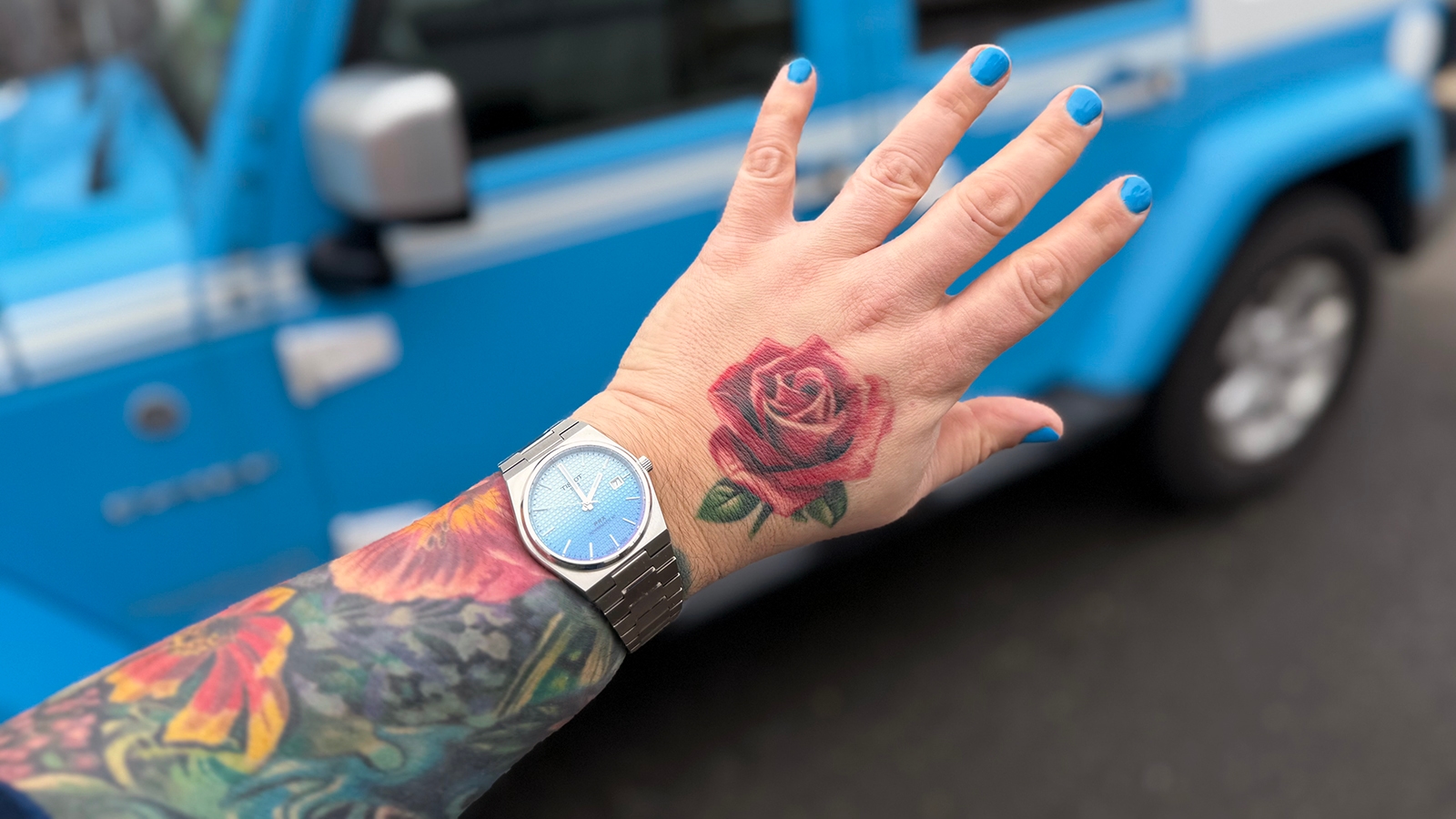
People smiled when they passed. Some complimented the shirt. Others, the tattoos. Others, the nails.
At one point, an older gentleman approached the woman I was with and asked her a question while gesturing toward me.
“What did you have to give him in return to get him to wear all of that?”
Without missing a beat, she replied.
“Look at him. He loves this. He did all of that himself.”
I added one detail he had overlooked.
“You missed the shoes.”
He laughed and gave a small nod of approval before continuing on his way.
The Magnetism of Color
One of the first comments about the nails came from a staff member running a cocktail stand. She froze mid-motion, looked down at my hands, and said something I’ve heard many times before.
“That blue is amazing.”
It reminded me immediately of the reactions I get to my Jeep, which happens to be the same color. People see a color that vivid and react almost instinctively.
There were other moments too.
A vendor wrapping ceramic planters looked up as I walked by and quietly said, “So cool,” before realizing he had spoken out loud.
Two women selling plants noticed the leaf tattoo on my hand, asked to see the rest of the arm, and then erupted into the kind of delighted disbelief that only happens when someone encounters something they truly appreciate.
The pattern repeated all afternoon.
Compliments. Curiosity. Double takes.
None of it felt strange. If anything, it felt like people were responding to something they rarely see.
The Problem With Safe Masculinity
There is a dominant aesthetic for men right now that I can only describe as safe masculinity. Black clothes. Black cars. Black tattoos. Black everything. We discussed this in an article about my Jeep Chief, how modern masculinity has become so monotone.
The aesthetic is so common that it has become invisible.
At some point, the idea took hold that masculinity needed to present itself through visual restraint. Muted colors. Minimal expression. Neutral palettes.
I have never understood the appeal.
Color exists for a reason. Individual taste exists for a reason. Changing your preferences simply to align with someone else’s idea of what you should look like feels like a strange kind of surrender.
When everyone drives the same road, they all arrive at the same destination.
I would rather build my own road.
The Brotherhood of Visible Difference
Recently, I was on my morning commute into Manhattan on the PATH train when I noticed an older man standing near me with elaborate nail art on every finger. At the time, my nails were painted a dark navy.
The man was dressed to the nines, and his nail polish was far from subtle. Each nail had its own unique nail art design. And I immediately felt kinship with this stranger whom I was just seeing for the first time. There was something instantly familiar about it.
Years ago, in 2002, I almost lost my right eye after a severe injury. For months, I had to wear an eye patch while traveling into Manhattan several times a week for treatment at the New York Eye and Ear Infirmary.
One afternoon, I was walking toward Penn Station to catch my train home when I saw another man approaching from the opposite direction. He was dressed in a tailored business suit and wore a beautifully crafted leather eye patch.
As we passed each other, we locked eyes.
He gave me a small smirk and a nod.
I nodded back instantly.
Neither of us said a word, but the meaning was clear.
We understood each other.
That is exactly what it felt like seeing the man with the nail art on the train at quarter after 7 in the morning, on my grueling commute to work.
A small moment of unspoken kinship between two people completely comfortable standing out in a crowd.
Taking the Dive
If a man is curious about painting his nails but has never tried it, the barrier is rarely the polish itself.
It is the moments before taking the leap. Like standing on the edge of a high dive and looking down at the water. Once you jump, the fear disappears. But the seconds before the leap feel enormous.
There is a small investment involved. You have to buy the tools. You have to learn how to do it. You have to accept that you will be terrible at first.
And eventually, you have to walk out into the world with your hands visible for everyone to see. At first, it will feel awkward. Self-conscious.
But once you cross that line and start feeling comfortable with your new form of expression, it simply becomes another part of who you are.
What Happens When You Stop Hiding
I believe the world would be more interesting if more men allowed themselves that kind of freedom.
Not because painted nails are inherently important. They are not.
But the confidence required to express yourself visually without asking permission changes how you move through the world.
It creates color where there was once monotone.
And sometimes, when another person sees it, they recognize something in themselves.
That recognition might appear as a compliment.
Or a laugh.
Or a quiet nod on a crowded train.
And sometimes that is all the connection two strangers need.
Latest From The Journal

When It Stops Being Just Yours
Owning something people want to talk about changes the experience. A reflection on taste, color, and making something fully your own.

Surviving a Week From Hell
A grounded look at how to re-enter work after a brutal week, when motivation is gone, energy is low, and all you can do is tread water.

Breaking Up With My Apple Watch
Letting go of my Apple Watch wasn’t a rejection of technology. It was a decision to protect my attention and dial back constant urgency.