
How plants, storms, late-night conversations, and a front-row seat to the neighborhood turned one porch into the heart of a home.
When I first moved in, the porch was usable but neglected.
The floor paint was worn. The railings and spindles needed attention. It was entirely empty, with none of the plants, furniture, or everyday rituals that define it now.
The structure itself was never the problem. The porch is solid as a rock. At some point, it was likely rebuilt or added after the house itself, because the lumber beneath it is far too modern to be 125 years old. Beneath the wooden steps, there are still traces of what were probably the original brick stairs leading to the front door.
Whatever version of the porch belonged to the house before me, the current one became mine almost immediately.
I was still a smoker when I bought the house, and because I never smoked indoors, the porch became the place where I would sit, think, and decompress. I quit smoking thirteen years ago, but by then the porch had already established itself as more than a place to step outside.
I read there. I napped there. I watched the neighborhood from above the sidewalk. The first furniture set included an outdoor loveseat and two chairs, and I remember falling asleep out there more than once.
The smoking eventually disappeared. The habit of retreating to the porch stayed.
When the Workday Turns Into a Porch Night
The version of the porch I love most usually begins with work.
I will spend the day in the yard, weeding flower beds, mowing, trimming shrubs, dragging brush to the curb, and fixing whatever has decided to become a problem that week. My Bluetooth Soundcore Motion Boom speaker follows me around in my garden cart while I work, playing loudly enough for me to hear but not loudly enough to become the neighborhood’s unwilling soundtrack.
Eventually, the tools get put away. The mower goes back into the garage. The brush pile is stacked at the curb. I sweep off the porch, refill the bird feeders, water the plants, and take one last look around for anything unfinished.
Then the day shifts.
The speaker moves to the small table between a pair of wicker egg chairs. I make a drink. Sometimes it is Scotch or bourbon. Sometimes it is a Manhattan, a Negroni, or a Rusty Nail. If it is a weeknight, especially now that I am trying to keep drinking limited to weekends, it may be nothing more dramatic than a decaf rooibos tea.
The drink is less important than the signal. The work is over.
That is how Porch Nights begin.
Sometimes I read. Sometimes I scroll through the news. Sometimes the music keeps playing while I sit there doing absolutely nothing. Other nights turn into long conversations about questions that sound urgent after midnight and ridiculous the next morning.
What song would play if you walked into a crowded room in slow motion in a movie?
What is the sexiest song of all time?
What is the one song you absolutely have to play on a jukebox by a particular artist?
These are not questions that improve civilization.
They do, however, tend to keep a Porch Night going until three or four in the morning.
The View Is Better Than It Sounds
The porch overlooks the overflow parking lot for a courthouse across the street. If that does not sound particularly picturesque, you are absolutely correct. What it lacks in beauty, however, it makes up for in unpredictability.
You never know what is going to happen in that parking lot. People exercise there. Families gather. School groups rehearse dances. One day, two men appeared in enormous illuminated robot costumes on stilts, towering over the asphalt while apparently practicing for some kind of show or parade.
People set off fireworks there every Fourth of July. It is still illegal and still annoying, but at least the choice of a giant paved lot suggests a flicker of responsibility to prevent fires.
Most consistently, people learn to drive there.
At almost any hour, someone is circling the courthouse lot under the guidance of a friend or family member. I have seen driving lessons happening at two in the morning on New Year’s Day, barely two hours after the ball dropped.
The constant headlights sweeping across the front of the house can make it feel as if we live across the street from a lighthouse.
One of those unofficial driving lessons once ended with a fifteen-year-old girl jumping two curbs and crashing her mother’s SUV directly into the porch, so my amusement has limits. The porch survived mostly unscathed. The brick foundation to the house was another matter, but that has all been since repaired.
Still, the parking lot provides an endless low-budget theater production. You never know what the plot is going to be for a given evening.
Looking Out Instead of Looking In
The backyard has its own gathering place.
There is a raised deck overlooking the property, with Adirondack chairs, a cantilevered umbrella, an outdoor fireplace, and a full supply of firewood nearby. It is comfortable and secluded, and I have spent plenty of late nights there.
For a long time, I could not explain why I still preferred the porch. While thinking through this article, the answer became obvious.
The back deck looks inward.
The porch looks outward.
From the back deck, I see the property. I see the gardens, the grass, the fence line, and whatever needs attention next. It is private and enclosed by the world I have built.
From the porch, I see beyond it.
I see neighbors walking by. I see people learning to drive. I see weather moving across the courthouse lot. I hear conversations from the sidewalk. I watch birds arrive at the feeders. I see the strange, ordinary activity of a town continuing whether I participate in it or not.
The porch lets me withdraw without disconnecting. That is the difference.
The porch lets me withdraw without disconnecting. That is the difference.
The Garden Comes Up to Meet It
In the warmer months, the porch is surrounded by plants.
The railing boxes are planted with impatiens, sweet potato vines, vinca vines, and several types of coleus. The arrangement follows a system I can only describe as structured randomness.
Every box may contain the same categories of plants, but the colors, varieties, and placement change. One box may have a bright green sweet potato vine, while another gets the nearly black variety. Each includes impatiens, but not necessarily the same color. The coleus changes from box to box, with different leaf shapes, patterns, and shades.
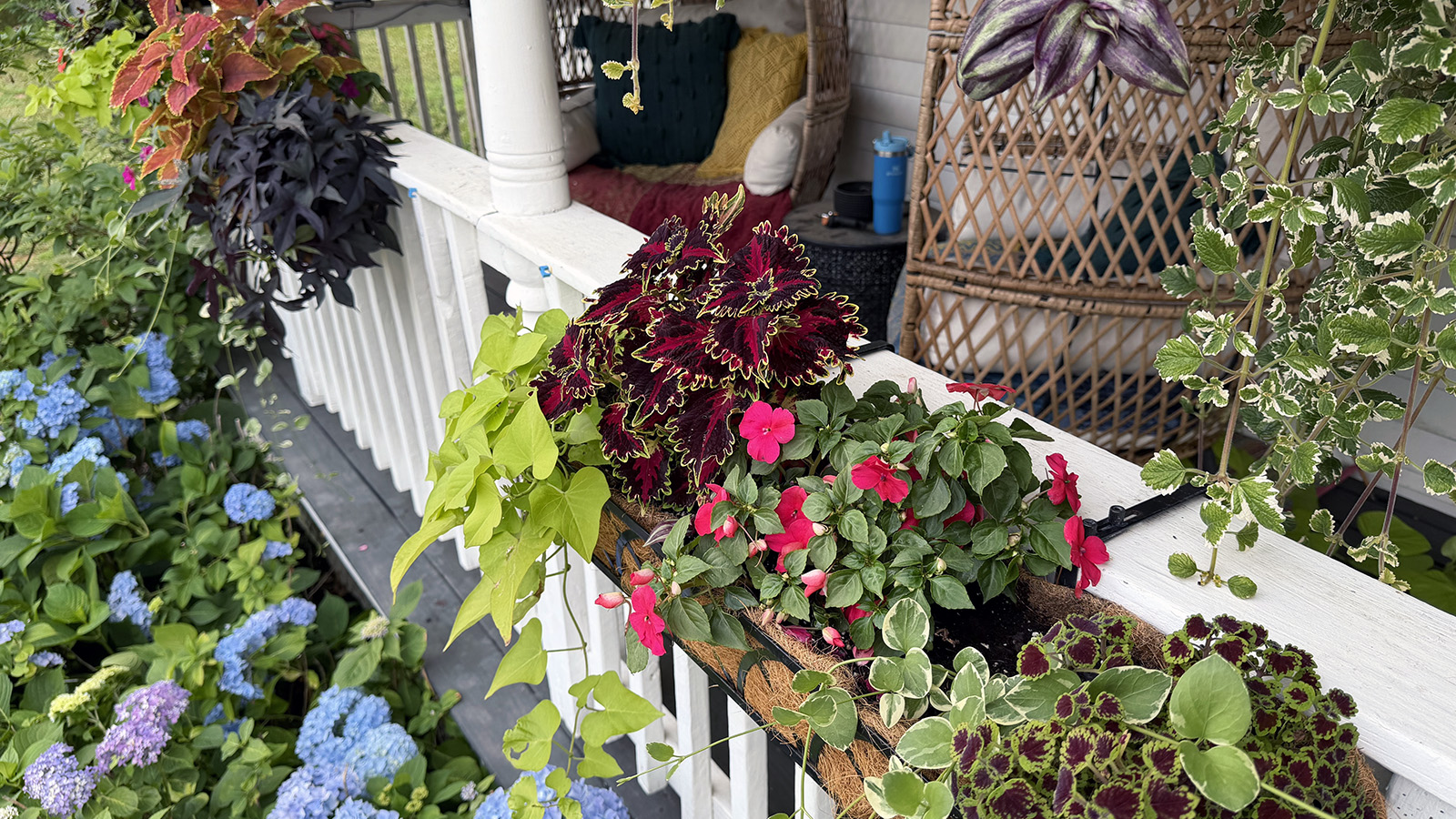
The hanging baskets are usually filled with trailing Purple Heart plants and Swiss ivy. A three-tier stand holds different caladiums and coleus. A Kimberley Queen fern spends the colder months struggling indoors before returning to the porch each spring like someone being released from captivity.
One large urn contains sweet potato vines that have become alarmingly ambitious this year. They crossed the floor, reached one of the egg chairs, climbed it, made it to the top, and have now started descending the other side.
Apparently, the chair belongs to them now.
A pair of giant Boston ferns normally hang at either end of the porch. We usually buy them small in spring and watch them grow until they dominate the endcaps by fall. In the fall, we offer them free to a good home because there is no realistic place to keep them indoors.
Someone always comes to get them.
Rehoming the ferns has become part of the seasonal rhythm too.
The Porch Does Not Maintain Itself
The finished porch looks easy. It is not.
Every spring, the furniture has to come out of the garage. The baskets need new coconut liners. The railing boxes need to be filled. There is a nursery trip, then a planting day, then the daily watering that continues for the rest of the season.
The birds get peanuts in the morning. The neighborhood cats and raccoons get kibble at night. A trail camera records whoever appears after dark, and every Friday morning I remove the SD card to see what visited that week.
The porch gets power-washed every year or two. The hydrangeas need deadheading and occasional shaping. The butterfly bush gets cut back before the final brush pickup of the season. The floor paint eventually suffers from weather, shoes, furniture, and winter shovels.
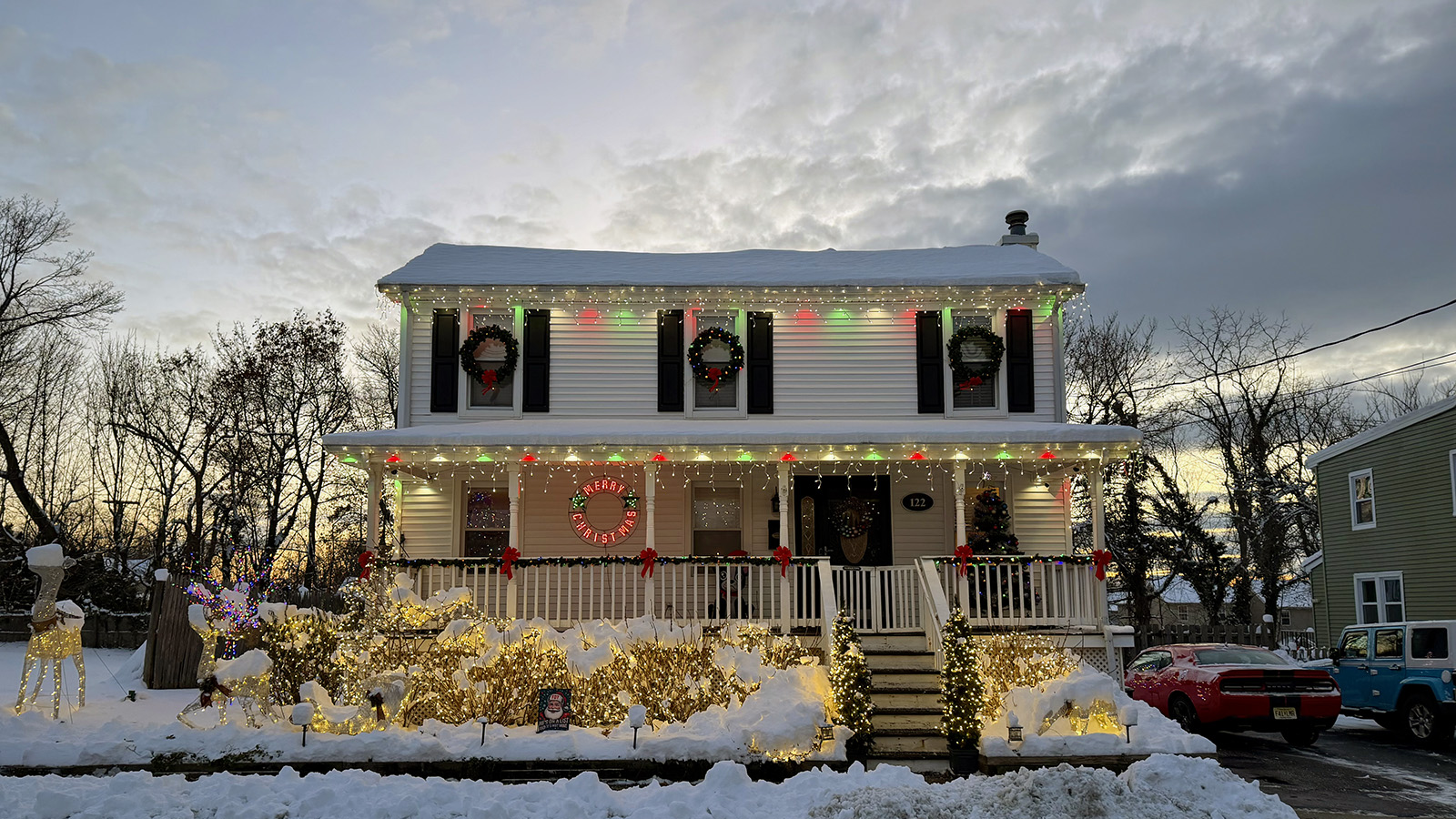
I still shovel every inch after a snowstorm, even when nobody needs access to most of it. Partly, it is habit. Partly, it is respect for the sanctity of the porch.
The least enjoyable part is putting everything away.
When the furniture returns to the garage and the plants disappear, the porch becomes stark. For two or three months, it feels less like a room and more like an empty platform attached to the front of the house.
Unless Christmas arrives.
Then the porch gets a tree, lights, garland, bows, and enough illumination to make the seasonal emptiness feel intentional.
Storms Are Better From the Porch
One of my favorite reasons to sit on the porch has nothing to do with plants or music.
It is weather.
When a thunderstorm starts moving in, I usually hear it before I see it. The thunder rolls in the distance. The wind changes. The air cools. Clouds begin stacking over the courthouse.
That is usually my cue to make a drink or brew tea and head outside.
The porch is protected from rain unless the wind is strong enough to send it sideways. Even then, the direction of the storm determines whether the furniture stays dry. From the shelter of the roof, I can watch the entire system arrive.
The first part is thrilling.
The wind picks up. Lightning flashes. Thunder becomes louder and more immediate. I watch the trees across the street and wonder whether the weaker branches are going to hold.
The dogs remain alert, scanning the street and sky.
Then the front moves through.
The wind settles. The rain becomes steady. The thunder drifts farther away. What had been violent and exhilarating becomes calm.
The dogs eventually stop monitoring the apocalypse and find somewhere comfortable to snooze.
The storm turns into background noise.
There is something deeply satisfying about being close enough to feel the weather without being exposed to it. Through a window, a storm is something happening outside. From the porch, you are a part of it.
The Dogs Have Claimed Their Places
My dogs, a Boston Terrier and a Brussels Griffon, have recently developed their own relationship with the porch.
They are now obsessed with nighttime porch time, particularly the Griff, who has started throwing tantrums when he decides we should be outside.
Once I figured out what he was demanding, a new weeknight routine emerged.
I make tea and bring them out.
I take one egg chair. The older Boston usually takes the other. The Griff walks to one end of the porch and sits by himself, staring into the distance with the grave expression of someone contemplating life’s great mysteries.
I have several photographs of him doing this.
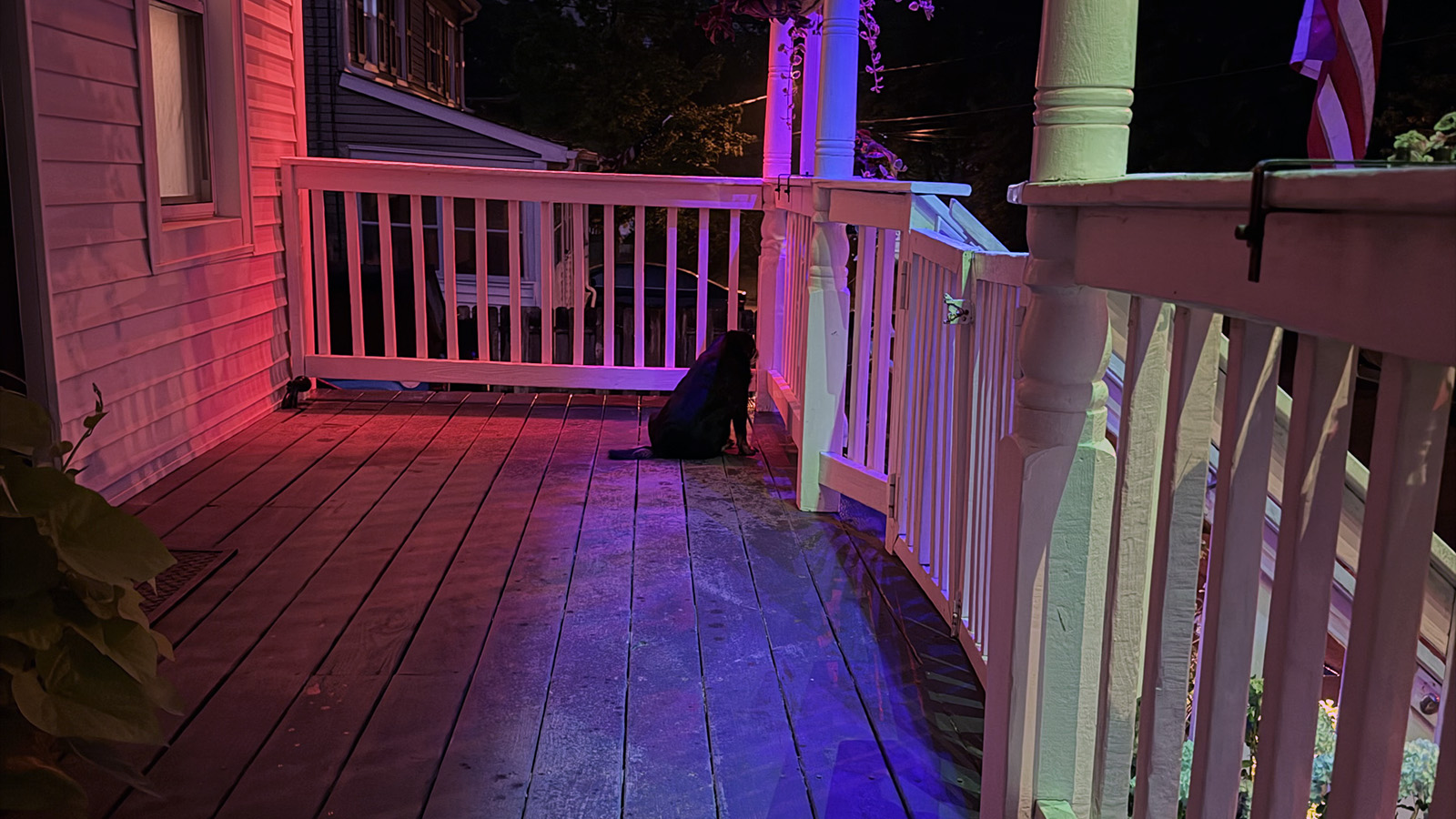
He is tiny, silent, and apparently carrying the full burden of the world.
The porch has always been a place where the dogs become part of whatever is happening. When we first bought the Boston home as a tiny 3-month-old puppy, it was where we introduced him to his older brothers, both of whom have since passed.
The photographs from that day still hurt to look at.
They also remind me that the porch has been home to many different versions of this household.
A Place to Talk When There Was Nowhere Else
During the early days of the pandemic, one of my closest friends needed to talk in person about something personally devastating.
At the time, everyone was still being careful about social distancing. We were afraid of being too close, afraid of being indoors, and desperate for some version of normal conversation.
The porch made it possible.
He sat at one end. I sat at the other. He brought a six-pack and rolled beers down the floorboards to me while we talked.
The circumstances were terrible, but the memory is strangely comforting.
The porch gave us a place to have that conversation safely. It let us sit face-to-face when almost every other part of life had been reduced to screens and distance.
It has done that in smaller ways too.
Neighbors stop to say hello while I water plants. Delivery drivers leave packages. Local politicians used to climb the steps to make their pitches until I finally added a no-soliciting sign. Friends and family gather there during parties, particularly anyone who still needs a place to smoke.
The porch is not especially social when I am sitting quietly. Because it is elevated above the sidewalk, most people passing by do not even realize I am there.
When I stand up, the relationship changes.
People compliment the flowers. They ask about the house. They mention the Christmas lights or the hydrangeas.
In those moments, the porch becomes part of the street, almost like a city stoop.
When a House Says Something
On the eve of the 2024 presidential election, a woman rang the doorbell.
I did not know her. She explained that she lived nearby with her wife and had stopped because she wanted to thank me.
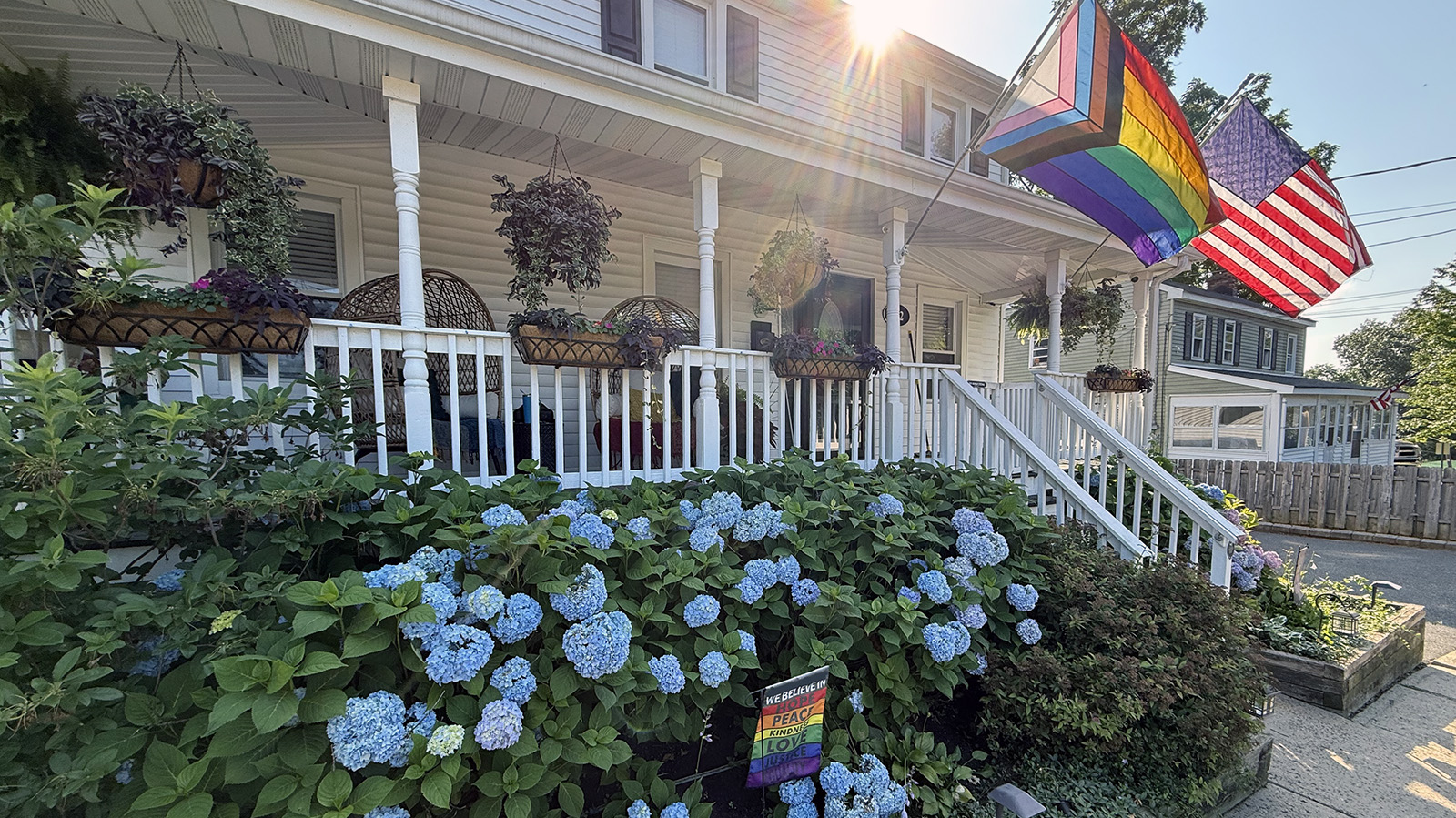
At the time, the house displayed a Harris-Walz flag and a sign opposing Project 2025. During June, I flew a Pride flag. Every Christmas, the house was covered in lights. Every 4th of July, there is bunting adorning the railings. The gardens and porch were always visible from the street.
She told me that seeing the house made her and her wife feel safe and welcome. More than that, she said it gave them hope.
I do not remember exactly what I said in response. The conversation happened quickly, and I was caught completely off guard.
What stayed with me was the realization that the house had been communicating something on my behalf even when I was not standing outside.
The porch, flags, flowers, and lights were all visible expressions of the people who lived there. I had always understood that I was putting myself out into the world.
I had never fully considered what it might mean to someone else.
That encounter became one of the reasons I later installed permanent exterior lights and worked so hard to create the perfect rainbow display for Pride.
Sometimes a house can signal, “You are safe here.”
And sometimes it turns out that matters more than the person inside realizes.
Sometimes a house can signal, “You are safe here.”
And sometimes it turns out that matters more than the person inside realizes.
Where the House Meets the World
A porch is not rare.
Lots of houses have them. Lots of houses do not.
People who live in apartments create the same feeling on balconies and patios. A chair, a few plants, a view of the street, and a place to sit outside can become far more important than the square footage suggests.
That may be why the porch matters so much to me.
It is not grand. It does not overlook mountains, water, or rolling countryside. It overlooks a courthouse parking lot where people rehearse dances, learn to drive, set off fireworks, and occasionally arrive dressed as illuminated eight-foot robots.
It is simply the place where this house meets the world.
The porch has been a place to smoke, then a place to quit smoking. A place to read, sleep, drink, grieve, celebrate, talk, watch storms, tend plants, photograph dogs, feed birds, and sit quietly while the neighborhood continues around me.
The kitchen may be the heart of some homes.
In this one, it’s the porch.
Latest From The Journal

Rebuilding Before the Next Job Arrives
Career rebuilding can start before the next job arrives, with routine, momentum, confidence, and a clearer sense of what comes next.
No Is Not the Beginning of a Negotiation
An honest reflection on boundaries, personal choice, and why declining an invitation does not mean rejecting the person who offered it.

I Knew Within Three Months. I Stayed for a Year.
I knew I’d made a mistake taking the role. The hard part wasn’t knowing. It was admitting it and taking action.