
Five pieces of beach gear tested through years of sun, wind, saltwater, sand, and ordinary trial and error.
There is no shortage of beach gear advice articles available online from reputable sources. Most of it falls into one of two categories.
The first is painfully obvious. Bring a water bottle. Bring a hat. Bring a phone charger. Bring something to keep your phone dry. This is less beach advice than a reminder that the sun is hot and water is wet.
The second category is more elaborate and somehow less useful. It recommends expensive products from recognizable brands, piles on features most people do not need, and treats a day at the beach like an expedition into an uncharted wilderness.
That was what pushed me to start thinking about my own beach setup.
I had seen one article recommending five “cheapish” things to bring to the beach. The list included hair ties, a water bottle, a sun hat, a portable charger, and a waterproof phone pouch. None of those are bad things to bring, but they are also the kinds of things most people who are familiar with the overall concept of a beach could figure out entirely on their own.
Another article offered a much longer guide to towels, chairs, umbrellas, coolers, bags, games, clothing, and almost everything else someone could possibly carry onto the sand. It was closer to the kind of article I wanted to read, but many of the recommendations felt disconnected from how people actually use beach gear.
There were premium towels from expensive lifestyle brands. A $160 tote bag for carrying wet clothing. A canvas bag with no closures or internal organization offered as an ideal beach bag. A cart without proper sand wheels that definitely lacked the capacity to carry the bare necessities. Coolers costing hundreds of dollars meant for a week-long trek entirely off the grid, not 8 hours on the sand.
Some of the recommendations were perfectly reasonable. Others seemed selected because the brand was familiar or the product looked good in a roundup. It felt like some of the recommendations were selected because the label carried more weight than the problem it was supposed to solve.
That is not how I think about beach gear.
I have spent years refining my setup through ordinary trial and error. Things have been added, replaced, modified, and removed. Some purchases worked immediately. Others revealed their flaws the first time the wind picked up or saltwater dried inside a zipper.
The items that remain are not necessarily the most expensive or the most stylish. They are the ones that solve a real problem and continue doing it reliably.
That is the Tattooed & Tweed definition of what makes something essential.
The Best Beach Gear Disappears Into the Day
When a piece of beach gear works properly, you stop thinking about it.
The umbrella stays firmly in the ground. The chair remains comfortable. Your drink and shades have somewhere to sit. The speaker plays all day without dying. The game comes out when people are feeling competitive and sets up in minutes without a construction committee.
That has become my standard.
I am not interested in buying the most advanced version of everything. I am interested in removing friction.
I am not interested in buying the most advanced version of everything. I am interested in removing friction. The beach already provides enough complications on its own. There is sand in everything. The wind changes without warning. The sun moves. The cooler seems to get heavier when it is time to leave. Someone inevitably forgets something in the car.
Good equipment should reduce that burden rather than add another thing to manage.
My setup has been evolving for years. It always functioned as a system because everything needed to fit in the beach cart, but the system has changed constantly.
The umbrella has gone through three versions. The chairs were upgraded more recently. The current speaker replaced a smaller one that I still loved but had outgrown. Other things have disappeared entirely.
I once carried a twenty-foot beach fence that was popular to use at beaches on Sandy Hook because it offered some privacy and kept people from setting up directly on top of you. It made sense there. I have never seen anyone use one in Asbury Park, and I am not even sure it would be allowed, so it now lives in the basement.
I bought a full kite setup that may still be buried somewhere in the cart. I have never used it.
That is part of refining any system. Some things prove themselves. Some things inevitably get pulled from the rotation.
The five items here survived because they made the day easier, more comfortable, or more enjoyable every time I used them.
The Umbrella I No Longer Have to Think About
iMPACT Rainbow Beach Umbrella
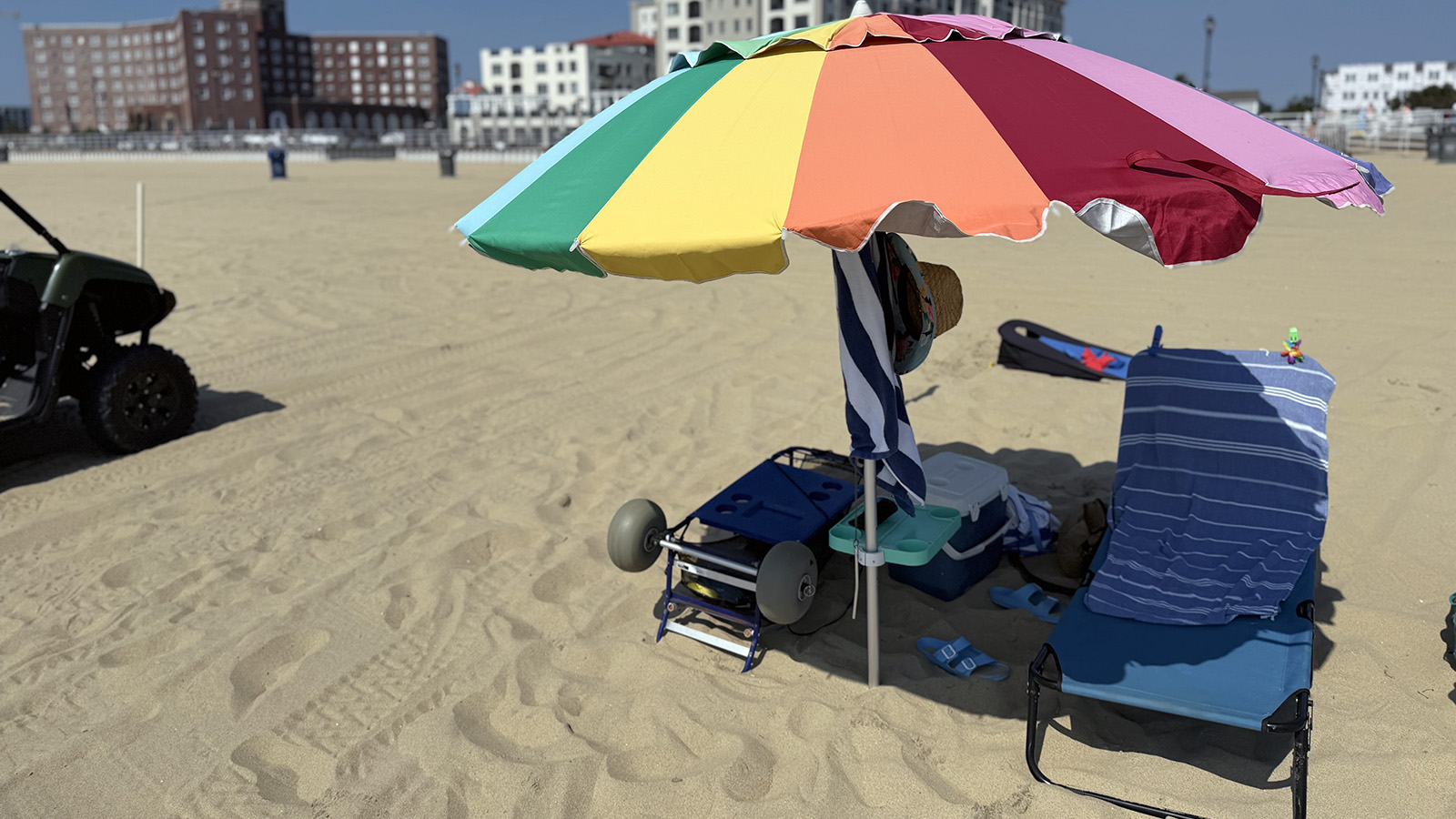
Shade at the beach is not optional for me.
I spend time in the sun, but I also take breaks under the umbrella. Sometimes the person I am with is fair-skinned and needs more protection than I do. Sometimes we are staying for most of the day and need somewhere to get out of direct sunlight.
The first shade system I used was a Sport-Brella. It worked reasonably well, but it came with limitations. Once it was set up, moving it meant pulling all the stakes out, rotating the entire assembly, and staking it down again. That was the only way to maintain shade as the sun moved.
Then, shore towns started tightening rules around tents and canopies. On many New Jersey beaches, the practical rule is that a shade device needs to have a single central pole. That took the Sport-Brella out of the rotation.
Its replacement was a typical Tommy Bahama beach umbrella.
To put it delicately, that umbrella was comically unreliable.
It was difficult to secure in the sand, and any meaningful breeze could turn it inside out. I started carrying the anchoring cords and spikes from the old Sport-Brella just to keep the Tommy Bahama umbrella from becoming airborne or folding backward.
That is the opposite of what an umbrella should do.
During one particular windy day, after I had to stake down the canopy to keep the umbrella from folding like a cheap… umbrella… I decided to solve the problem by studying my surroundings. I began paying attention to the umbrellas around me. On windy beach days, I watched which ones bent, which ones twisted, and which ones simply stayed where they were.
That led me to the eight-foot rainbow umbrella I use now. I saw multiple people with the same 8-foot rainbow umbrella, and in every instance, they were solid as a rock, while dozens of other beachgoers were wrestling with their Tommy Bahama models. When I got home, I was off to Amazon to try to track it down. Multiple sellers are offering this umbrella at various prices around $65. The iMPACT Rainbow Beach Umbrella appears to be identical to the one that I have been using for the last seven years.
When it arrived, the difference in construction was immediately obvious. The Tommy Bahama umbrella had eight fiberglass ribs. This one has sixteen. The load is distributed across twice as many supports. I cannot tell you its official maximum wind rating because I have never found one. What I can tell you is that it has never flinched in any beach wind I have experienced.
It has never turned inside out. It has never felt unstable. It has never tried to pull free from the sand and impale a stranger. The fabric has never faded and is just as vibrant as the day I bought it.
I set it up, and then I forget about it.
That is exactly what I want from beach gear.
As the sun moves, I shift the chairs around the pole instead of dismantling the entire shade structure. If something happened to this umbrella tomorrow, I would buy the same one again without even considering researching alternatives.
That may be the strongest recommendation I can give anything.
The Chair That Replaced the Chair Everyone Owns
The GYMAX Foldable Tanning Chair
The Tommy Bahama backpack chair may be the official chair of the Jersey Shore.
Everyone has one.
I used them for years. I still have two in the basement, and when my parents recently forgot their chairs on a trip to Asbury Park, I brought them along. From where we were sitting, I could see two other families using the exact same chairs in the exact same pattern.
They are popular for a reason. They are easy to carry, relatively affordable, and familiar.
They are also not especially comfortable.
They sit low to the ground, which makes getting in and out of them less pleasant than it needs to be. The rear storage pockets sound useful, including one designed to function as a cooler, but saltwater eventually creates another problem. When wet skin soaks the chair fabric, the salt can get into the zippers. Once it dries there, those zippers can freeze shut.
Getting them open again is an event.
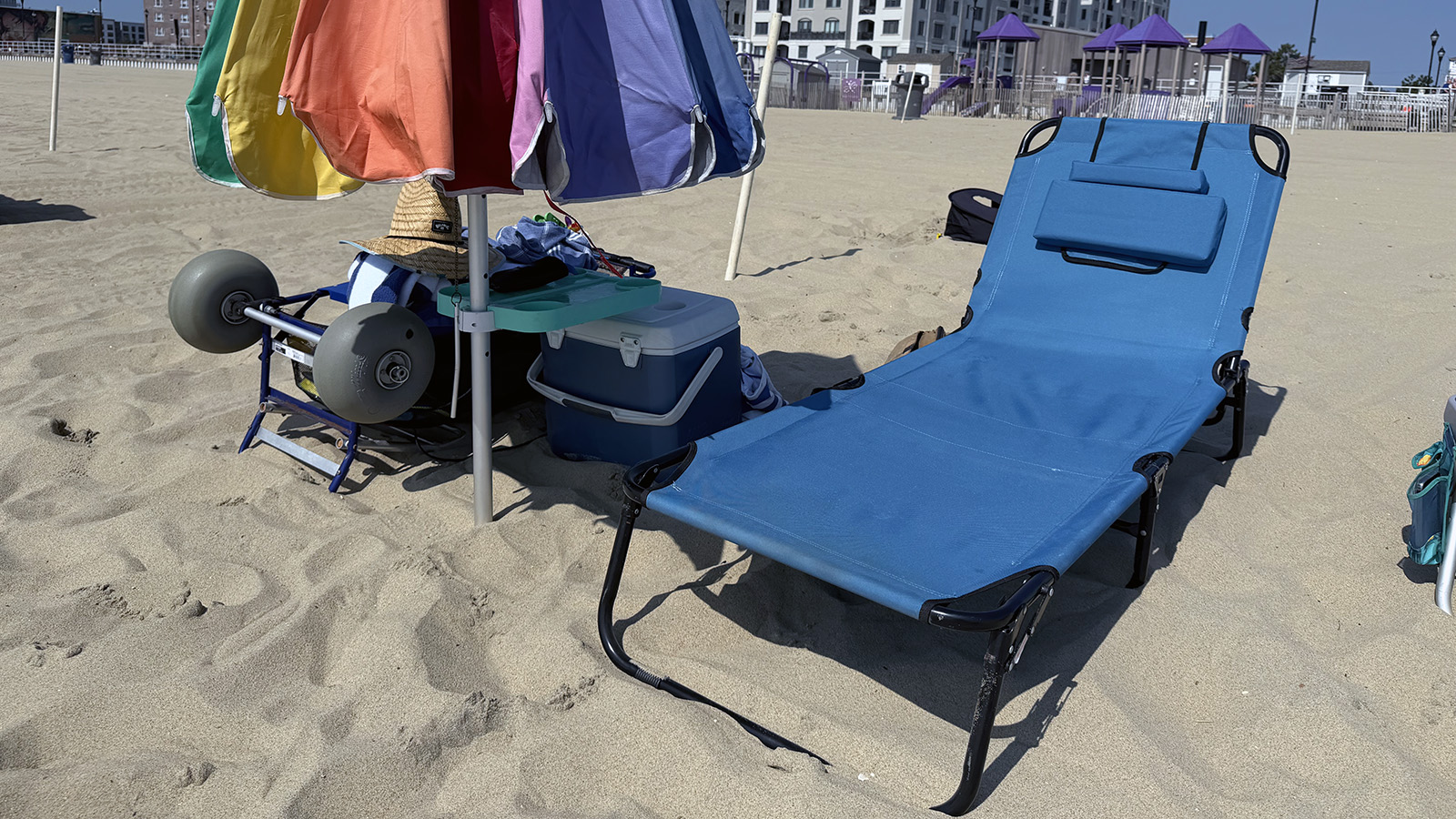
My current chair was the only thing I have ever bought from Temu. It is no longer sold there, but the same design is now available through GYMAX and several major retailers as the GYMAX Foldable Tanning Chair.
It solved nearly every complaint I had about standard beach chairs.
The chair can lie completely flat for sitting on your back or stomach. It includes a face opening, which means you can read or look at your phone while lying facedown without twisting your neck. The back adjusts to multiple heights. The lower section can remain elevated or drop toward the sand to create a more traditional chaise configuration.
Your legs are off the ground. You are not sitting as low. It is easier to get in and out of. It gives you more ways to position yourself throughout the day.
The simplest way I can describe it is that it brings the comfort of a poolside resort lounge chair onto the beach.
It is sturdy, lightweight, easy to carry, and simple to configure. I am now in my second season using it, and I have not found a reason to replace it.
That is unusual for me. Even when I like something, I tend to notice where it could be improved.
With this chair, nothing is jumping out at me.
The Umbrella Table That Brings Some Civility to the Sand
The BeachBub Table Tray System
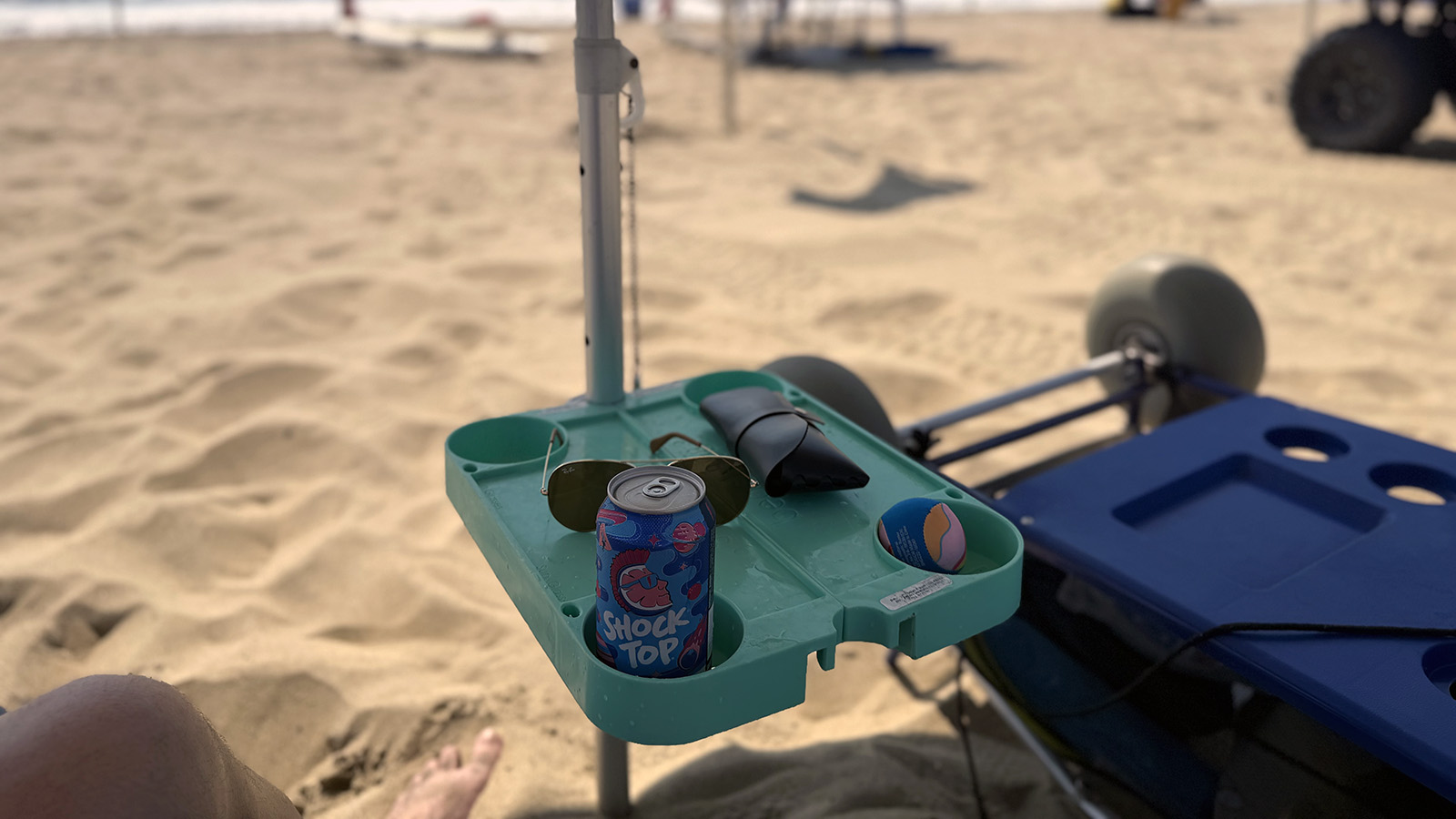
The umbrella pole table may be the least exciting item on this list.
It may also be the one I would miss fastest.
There is almost nowhere to put anything at the beach. You either balance it on your chair, place it inside a bag, hand it to someone else, or put it directly on the sand and accept what happens next. Maybe your cooler has a flat lid and cup holders, but anything you place there needs to be removed in order to open it.
The BeachBub Table Tray System mounts to the umbrella pole using a collar that can remain in place when the umbrella is packed away. The table itself is made from two halves, which can be joined into a single surface or used separately.
It includes four cup holders and enough flat space for a phone, sunglasses, sunscreen, lunch, keys, or anything else you do not want buried in sand.
That sounds minor until you have it.
Then you realize how often you need somewhere to put something down.
It keeps drinks upright. It keeps sunscreen out of the sand. It gives phones and sunglasses a temporary home. It gives your sandwich a fighting chance.
The collar does not interfere with the umbrella’s operation, and the pole still fits comfortably inside its carrying sleeve. Once it is installed, there is no reason to remove it.
It brings some civility to the beach.
That may sound dramatic for a plastic table attached to an umbrella, but that’s a hill I’m willing to die on.
Portable Cornhole Makes the Beach More Social
Himal Portable Cornhole Board Set
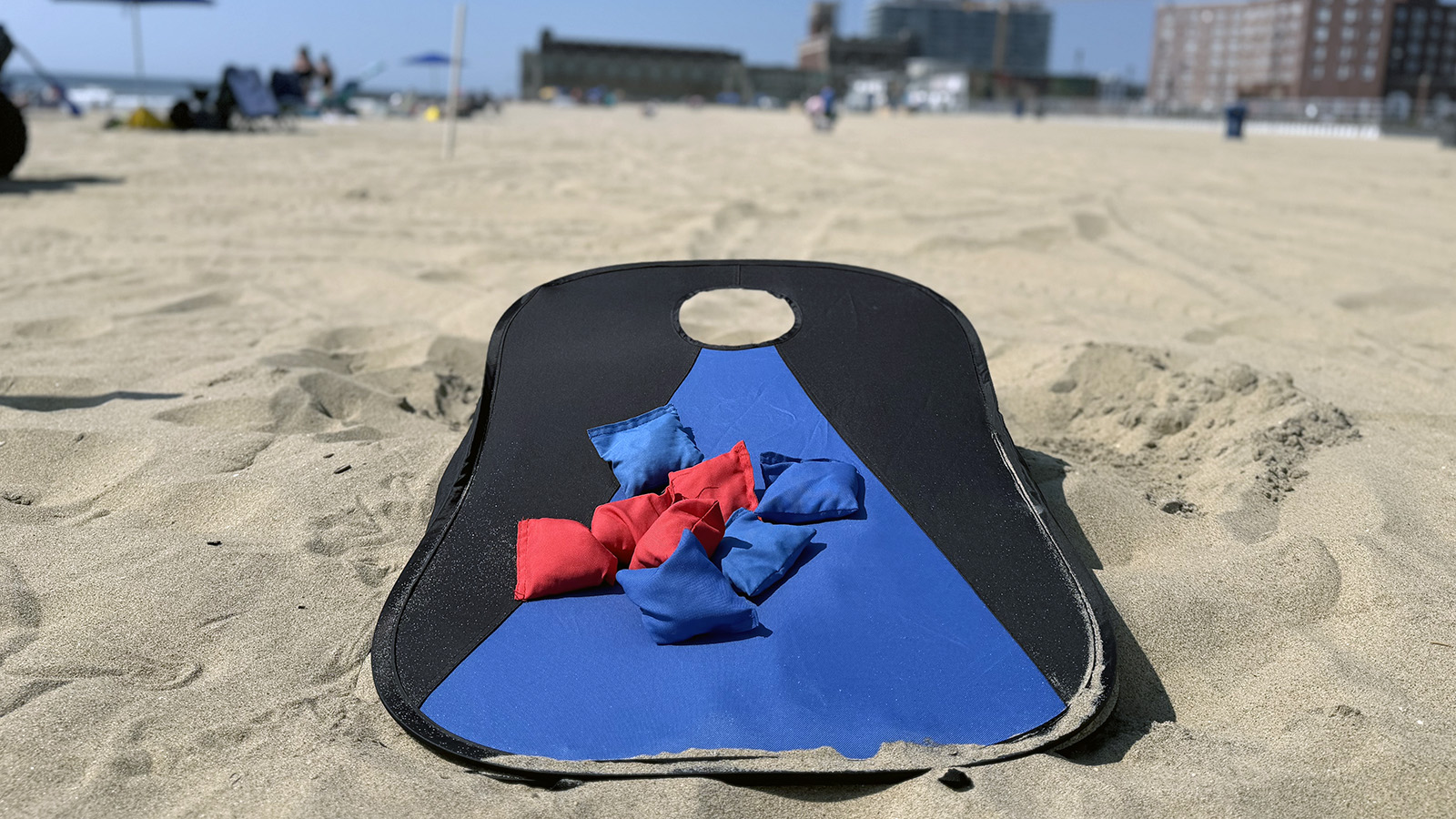
I could have included several beach games here.
My family plays paddleball and likes setting records we can try to beat. My father and I throw a floating skim ball back and forth in the water between waves. I have owned enough Aerobie toys to stock a small recreation department.
Cornhole earned the spot because it does something different. It is familiar enough that virtually anyone can play, but I rarely see anyone bring it to the beach.
The Himal Portable Cornhole Board Set is lightweight and easy to fit into the cart. The boards are smaller and less substantial than full-size backyard boards, which initially created a problem. The beanbags bounced on them like a trampoline instead of sliding across the surface.
I eventually figured out that shoveling sand into the hollow underside of each board gave them enough weight and stability to behave more like a traditional cornhole set.
The shore breeze adds another variable. You cannot throw exactly the way you would in a backyard because the lightweight, smaller bags drift. Factoring in the wind while playing sounds like it would be bothersome, but it actually becomes a fun and challenging aspect to the game.
It’s as if beach cornhole becomes an entirely different game in its own right.
More importantly, it brings people together.
Someone plays a game. Someone else calls next. Someone asks for the best two out of three, which inevitably turns into the best three out of five. It creates a little pocket of friendly competition without requiring much skill or explanation.
I also offer it to people sitting nearby, especially families with children or anyone who seems like they would enjoy it. Some have taken me up on it.
At that point, the game becomes an icebreaker. You start talking to strangers. People hang around. The beach feels a little more communal.
It is not just something to fill time. It changes the energy around your setup.
The Speaker With Enough Power and Enough Restraint
Soundcore Motion Boom
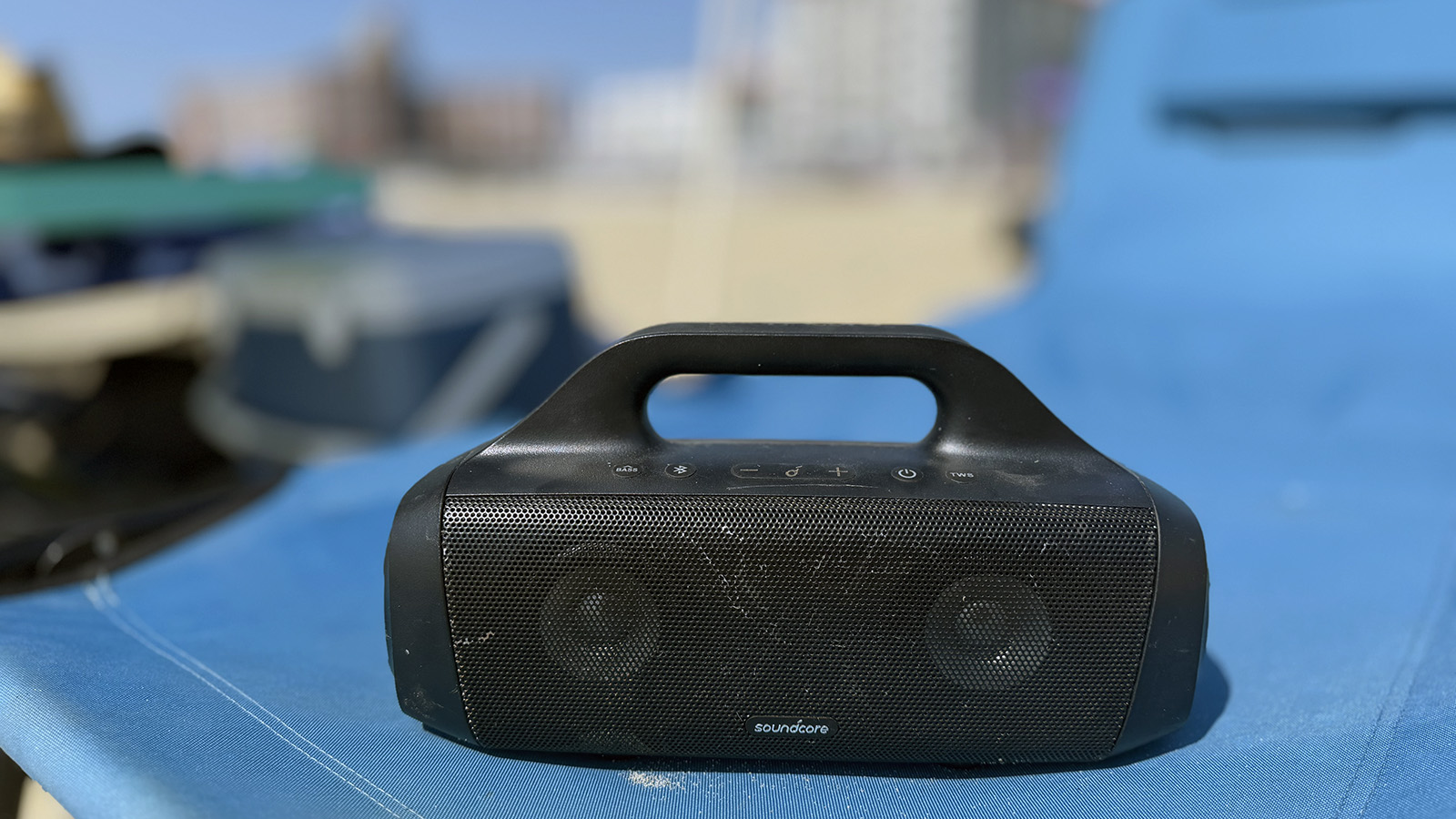
My first beach speaker was a Cambridge SoundWorks OontZ. It was tiny, making it exceptionally portable, lasted most of the day on a charge, and punched well above its weight class in sound quality. I used it on the beach, on canoe trips, vacations, and anywhere else I needed music without electricity nearby.
Eventually, I wanted something with more power, especially in the lower end.
The Soundcore Motion Boom was an upgrade in every way. It is louder, fuller, more durable, and rated for up to twenty-four hours of battery life on a charge. It works at the beach, on the porch, in the backyard, and on overnight camping trips.
It has enough sound to handle open spaces without becoming harsh or thin.
The challenge is knowing when to stop turning it up.
One of my biggest beach annoyances is someone playing music loudly enough that every surrounding group is forced to participate in their playlist. I would never want to become that person. I’m not trying to DJ for everyone in my vicinity.
When I set up the Motion Boom, I place it directly in front of our chairs with the speakers facing us. Then I walk around the outside of our setup.
If I can clearly hear it ten feet away, it is too loud.
The goal is not to provide entertainment for the entire beach. The goal is to create atmosphere inside our own space.
The beach is a better place when everyone is considerate of their surroundings.
What Did Not Make the List
This is not the complete beach kit.
I did not include towels, bags, water bottles, coolers, paddleball sets, skim balls, or the small plastic ring with hooks that attaches to the umbrella pole and costs less than six dollars. That hook ring is one of my favorite pieces of gear. It gives you somewhere to hang a hat, shirt, or wet towel, keeping everything off the sand while allowing it to dry.
The only reason it didn't make this list is that if I didn’t limit the number of items, the article would have been a mile long. Some things needed to be left out for brevity.
The same is true for the beach cart itself.
The cart is the backbone of the entire setup. It began as a commercial upright beach cart with a plastic back that doubles as a table. Over the years, I modified it with balloon sand wheels, a fold-out cooler shelf, and a few other additions that make transporting everything from the parking lot to the sand an easy one-handed job.
Without it, the rest of this system becomes much harder to manage.
The truth is that I could easily write another article about the cart, another about beach games, another about coolers, and another about the small accessories that quietly solve problems all day long.
Maybe that's the real takeaway.
After years of beach trips, I still haven't finished refining the setup.
Every season, something gets upgraded, replaced, added, or removed. Some purchases become permanent parts of the kit. Others are relegated to the basement.
This list represents the five items that have earned their place right now. That's part of the fun. The setup is never really finished. Every season brings a new idea, a better solution, or a piece of gear that proves it deserves a permanent place in the cart.
I’m already thinking about which items I’ll include in next summer’s article.
Good Gear Should Make the Day Easier
All five items have one thing in common.
They perform the job they were purchased to do without requiring compromise.
The umbrella stays put. The chair is comfortable. The table keeps important things out of the sand. Cornhole gives people something to do together. The speaker provides exceptional battery life and sound quality without forcing it on everyone nearby.
None of these products is revolutionary. None requires an expensive brand name or a complicated explanation.
They simply work.
That is what I look for when I recommend something through Tattooed & Tweed. These are not products selected from a catalog because they fit a category. They are things I own, use, carry onto the sand, and would replace with the same item if something happened to them.
The beach is beautiful, but it is also a harsh environment for equipment. Sun, wind, saltwater, sunscreen, and sand have a way of quickly exposing a weak design. Features that sound impressive online become irrelevant when a zipper freezes, an umbrella folds backward, or a cart cannot move through loose sand.
The gear that earns its place is the gear that makes the day easier.
The best beach gear adds comfort without creating work. It solves a problem without becoming another problem.
It adds comfort without creating work. It solves a problem without becoming another problem. It’s something you don’t even have to think about once it’s set up. It brings a little functional civility to a place where almost everything eventually gets wet and/or sandy.
To me, that is a much more useful definition of essential than anything chosen because of the logo stitched onto it.
Latest From Travel
The Travel Bag I Made Mine
A handmade leather travel bag became truly mine through years of use, commuting, and a few smart modifications that made it fit my life.

Phoenix & The Sonoran Desert
Phoenix is more than a desert city. Late fall reveals the Sonoran landscape, food, hikes, water, and wild contrasts that define it.
What to Know Before Visiting New Jersey’s Nude Beach
A candid guide to Gunnison’s etiquette, long trek, body-positive culture, and surprisingly ordinary atmosphere.