
How years of travel, commuting, and a few stubborn annoyances turned a handmade leather bag into something entirely my own.
I have a long history of buying cross-body bags that look perfect online and turn out to be anything but.
Sometimes they are far larger and bulkier than they seemed in product photos. Sometimes they are smaller than the product page dimensions led me to believe. Sometimes the materials look considerably better in a carefully lit product photo than they do sitting on my office desk.
The only thing I have ever bought from an Instagram ad was a cross-body bag I fell in love with online. When it arrived, the laptop compartment was too small for the MacBook Pro it was supposedly designed to fit, and the entire thing smelled so strongly and unpleasantly that I had to put it in the basement to air out for several weeks before I could use it.
Eventually the smell ebbed, and I began using it for my everyday work bag.
Shortly after, the interior lining began tearing away at the seams. In hindsight, it was a real piece of shit.
So when I started looking for another bag, I had some history working against me.
This time I was shopping for a specific reason. I had a trip to Ireland, Scotland, and England coming up, and I wanted a personal item that could stay with me on the plane and then become my everyday bag once I arrived. Something I could carry through Dublin, Edinburgh, and London, or have beside me while making my way around the Ring of Kerry.
I wanted a cross-body bag rather than a backpack because, outside of situations where I am hauling a lot of camera equipment, I simply prefer the way one looks and carries. A backpack has its place. I own a Pacsafe theft-deterrent backpack specifically for days when I need a DSLR, multiple lenses, a tripod, a flash, and enough weather protection to keep all of it alive.
But for walking around a city, getting on a train, sitting in an airport, or going out for the day, I want a bag at my side.
And this time, I wanted leather.
I had spent enough time trying to find the right waxed canvas bag. Nothing quite worked. I looked at the usual retailers and found nothing that grabbed me. Eventually I landed on an eBay store belonging to a leather crafter.
And there it was.
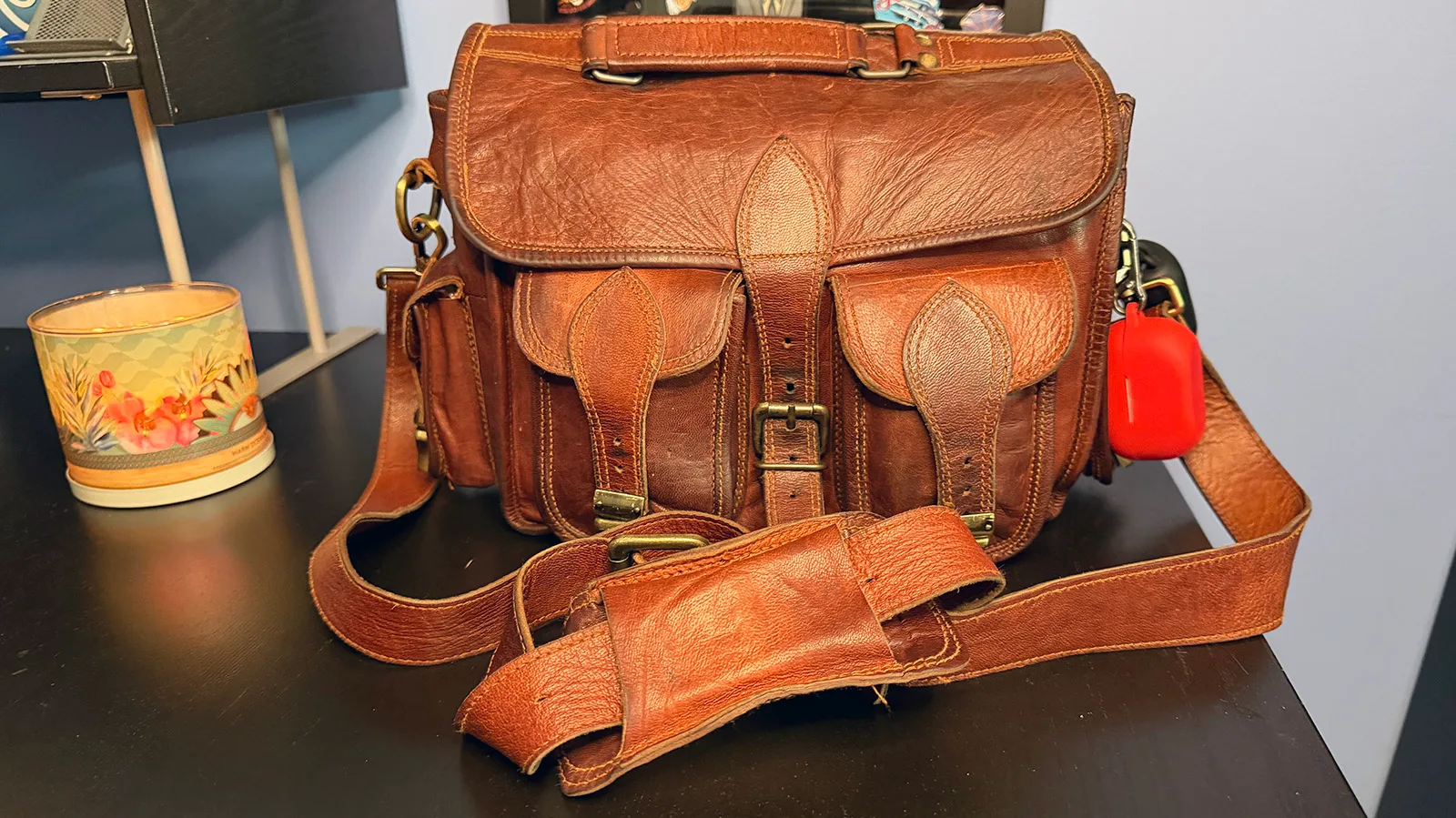
Warm orangey-brown goat leather. Antiqued brass hardware. Slightly old-world, slightly Old West, maybe just enough Indiana Jones vibes to get my attention.
It was technically being sold as a DSLR camera bag.
But it became so much more than that.
Close Enough to Perfect
When it arrived, I loved it immediately.
The leather had a different feel from the thicker cowhide I was used to, but it never felt cheap. It felt handmade and substantial. It smelled like leather and nothing else. The size was exactly right.
Most importantly, it was ready to use the moment it came out of the shipping box.
The irritations I had with it came later.
There were small leather pockets across the front and sides of the bag, all closed with traditional straps and buckles. They looked great. They were also annoying as hell.
Every time I wanted something from one of those pockets, I had to unbuckle it, retrieve whatever I needed, then buckle it again. That is charming if you are admiring a bag sitting on a shelf. It becomes considerably less charming when you are standing in an airport or commuting on a train and trying to grab something quickly.
The shoulder strap had its own problem. It was permanently attached to the bag, which meant it had an almost supernatural ability to twist itself inside out. The shoulder pad slid around. The strap twisted inside the pad. All of these were minor grievances, and nothing was catastrophic enough to make me dislike the bag.
It was just irritating enough to notice.
Then I would come home, put the bag in the closet, and forget about all of it until the next trip.
Eventually, I Got Tired of Being Annoyed
The turning point came when the bag stopped being occasional travel gear and became my daily commuting bag.
For a while, I was carrying a full-sized leather messenger bag to Manhattan because it could hold my 15-inch work laptop. Eventually, I realized there was no practical reason to haul that laptop back and forth every day. Once I started locking it in my desk at the office, the larger messenger bag became unnecessary.
The smaller leather bag suddenly became the obvious choice. And once I started using it every day, the little annoyances stopped being little.
That was when the obvious solution finally clicked.
I customize things constantly. I’ve always had a DIY mentality.
My house wasn’t perfect when I bought it, but it had good bones, and I renovated inside and out to my tastes. I have modified my Jeep extensively to make it my own. I completely rebuilt a tobacco sunburst Fender Strat because, to my eye, tortoiseshell and gold hardware belong on a tobacco sunburst guitar far more than white plastic and chrome ever will.
Making something more mine is hardly foreign territory. Yet somehow I had lived with this bag's annoyances for months before realizing the simplest solution was to fix them myself.
Making something more mine is hardly foreign territory. Yet somehow I had lived with this bag's annoyances for months before realizing the simplest solution was to fix them myself.
So I did.
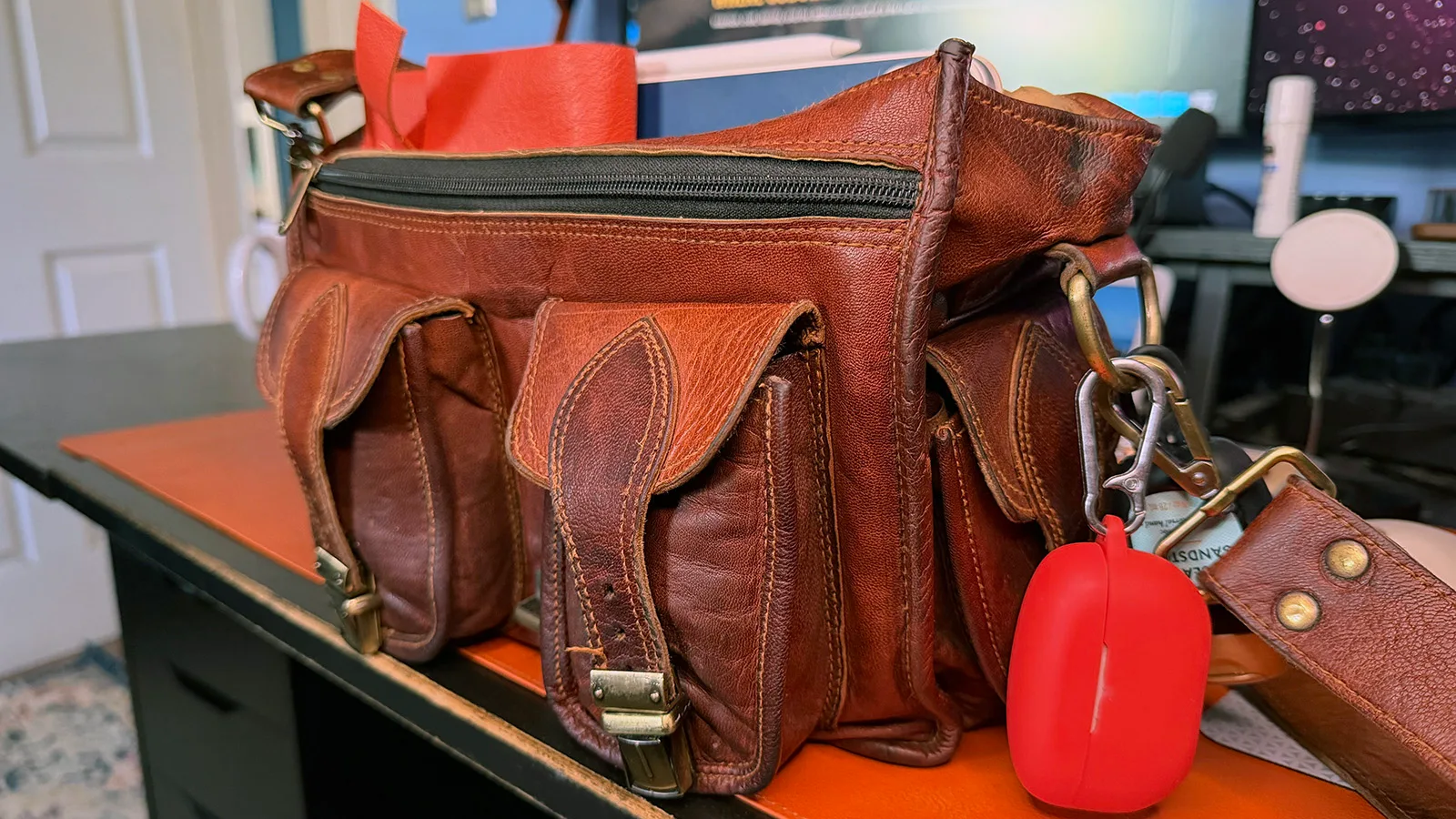
The buckles on the small pockets came off and were replaced with antique-brass quick-release fasteners. They preserved the look of the bag while making those pockets infinitely easier to use.
The permanently attached strap required more experimentation.
My first attempt involved replacement hardware with threaded pins. In theory, it was elegant because I could change the hardware without cutting or damaging the leather.
In practice, motion eventually worked the pins loose.
Twice, the pins unscrewed themselves enough for the hardware to let go and the bag to drop straight to the ground.
I tried threadlocker. It didn’t work.
The bag remained unconvinced.
Eventually I stopped trying to be clever.
I bought solid, heavy-duty D-rings in matching antique brass. I cut a narrow opening in each one with bolt cutters in an area that wouldn’t be visible, bent them open with pliers, worked them through the leather loops sewn into the bag, then closed them again.
Those things are not coming apart. I suspect the strap itself would fail before those rings did.
With proper D-rings in place, I could add swivel clasps to the strap. That solved the twisting problem immediately because the strap could now rotate freely instead of gradually turning itself into a leather Möbius strip.
The last irritation was the sliding shoulder pad.
Adjustability makes sense in theory. In reality, I am 6'4". The strap lives at its maximum length. It has lived there for years. There was no reason for the shoulder pad to continue wandering around like it was still searching for its purpose in life.
My initial idea was to use snaps or rivets to fix it in place, but I realized I was overengineering the problem.
A strip of absurdly strong clear acrylic mounting tape locked the shoulder pad exactly where I wanted it, invisibly, and it has not moved since.
The whole initial set of modifications probably took less than an hour. There was some trial and error afterward, but eventually I had exactly what I wanted.
Everything Has a Place
Part of the reason this bag works so well for travel is that I know exactly where everything goes.
The small rear side pocket always carries tissues. The front side pocket usually holds my earbuds, although when I am flying, their case gets clipped directly to one of the front D-rings so I can get to them constantly without opening anything.
A hand sanitizer hangs beside them.
One front pocket holds things I want with me but do not reach for constantly: lip balm, lens cleaner and cloths for my glasses, a small bottle of fragrance, liquid sweetener for coffee or tea.
The other holds the things that see more regular use: a beard brush, mustache wax, dental picks, my Gerber Dime multitool, and the tiny WUBEN flashlight I have written about before.
The main compartment changes depending on the day.
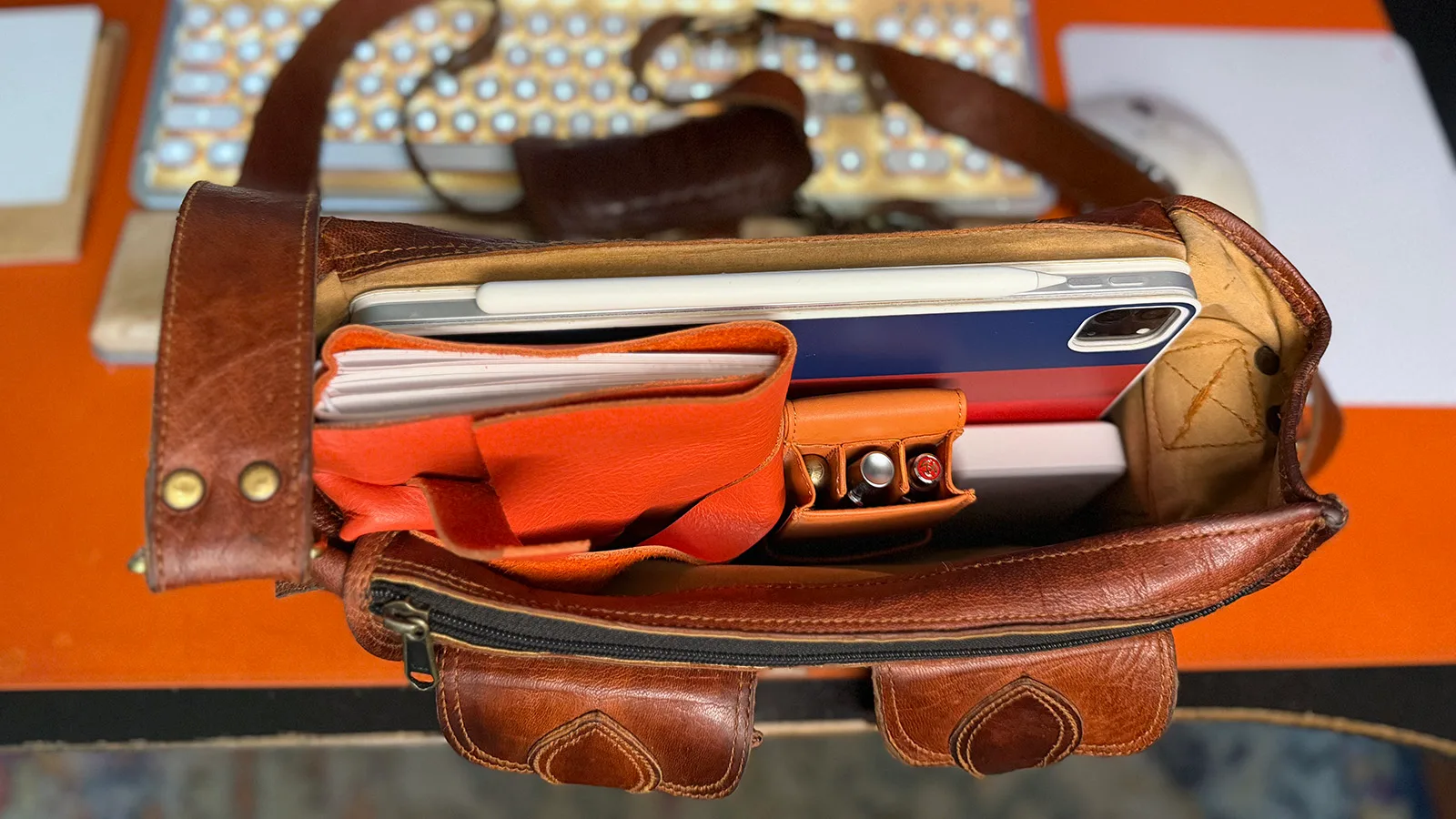
For travel, my Anker power bank goes in. My 11-inch iPad Pro with Magic Keyboard fits perfectly against the back wall. If I am flying, I add the Bluetooth transmitter I use with seatback entertainment. If I am renting a car, there will usually be a small mesh pouch holding whatever cables I need, along with the dash cam I bring for rentals. I have written about before, too.
There might be a water bottle. A travel mug. An umbrella.
There are always pens, usually my fountain pens and a small notebook.
This probably sounds like a lot for a relatively small bag.
It does not feel like a lot when you know precisely where everything belongs and can reach for it instinctively.
And there is an important distinction here.
This is not a bag full of solutions to imaginary emergencies. These are simply the things that make being away from home easier.
I have written before about learning not to pack for anxiety. This is not a bag full of solutions to imaginary emergencies. These are simply the things that make being away from home easier.
They remove friction.
Once I am through airport security, the few liquids I pulled out for screening go right back into their usual pockets. I do not have to wonder where the lens cleaner is or dig through another suitcase for the hand sanitizer. The things I know I will use are within reach.
That is exactly what a personal item should do.
From Airports to Manhattan
Using the bag every day during my commute was probably the best test it ever received.
Once the laptop was no longer coming home with me, there was no reason to carry the larger messenger bag. The smaller bag held everything I actually needed: water bottle, travel mug, umbrella, sometimes my iPad or e-reader, along with all of the smaller everyday things that already lived in its pockets.
The difference in weight alone was enormous, and on crowded trains, that mattered.
There were plenty of evenings during rush hour when I was standing in an aisle for the ride home. Carrying a heavy laptop on one shoulder made an already unpleasant commute noticeably worse. Losing that weight was an order-of-magnitude improvement.
The smaller footprint helped too.
It was easier moving through packed stations and crowded sidewalks. There was less bag sticking out behind me, less chance of knocking into somebody, less bulk to manage while getting on and off trains.
Something I had originally bought for walking through Dublin, Edinburgh, and London had quietly become the perfect bag for moving through Manhattan.
Travel gear has a funny way of proving itself outside of travel.
Worn In, Not Worn Out
After years of use, the bag has changed surprisingly little.
The leather has darkened slightly. The side of the shoulder pad that rests against me has become darker and shinier. The same thing has happened at the pressure points along the bottom where the bag rests when I set it down.
The grain has become much more pronounced.
Mostly, though, the difference is in the feel.
The leather that arrived relatively stiff is now soft and supple. There are no cracks, no failing seams, no structural problems. It simply feels lived in.
That may be my favorite way for leather to age.
Not distressed for effect. Not artificially weathered.
Just used.
Seeing it closely again while working on this article has also reminded me that it is probably due for some conditioning. A little maintenance seems like a reasonable return on something that has spent this many years being dragged through airports, cities, trains, hotels, rental cars, and ordinary days.
I expect it to be around for a very long time.
Before I customized this bag, it was an object I owned. Afterward, it became my bag. Mine.
When an Object Becomes Yours
Before I customized this bag, it was an object I owned.
Afterward, it became my bag.
Mine.
I did not buy it because I saw potential hidden underneath its flaws. I bought it because I loved it. The fact that the things I disliked could be changed came later.
But that experience taught me something useful about buying gear.
Something does not necessarily have to arrive perfect.
Sometimes what matters more is whether the fundamentals are right.
The leather was right. The size was right. The construction was right. The proportions were right. The look was right.
A few irritating pieces of hardware were not reasons to replace something that otherwise worked beautifully.
They were valid reasons to make it better.
I tend to keep leather goods until they give me no other choice. I have owned leather jackets until they were simply too damaged to continue wearing. I have two pairs of Frye boots that are around fourteen years old, worn through fall, winter, and early spring. I’ve had to have those resoled twice.
I see no reason this bag should be any different.
It already does everything I need it to do. Every clasp is where I want it. The strap falls where I want it. The things I carry have settled into their places. The leather has become supple over years of use.
Barring some catastrophe, I cannot imagine replacing it.
At this point, buying another one would not really be an upgrade.
It would just mean starting over.
Latest From Travel

Phoenix & The Sonoran Desert
Phoenix is more than a desert city. Late fall reveals the Sonoran landscape, food, hikes, water, and wild contrasts that define it.

What to Know Before Visiting New Jersey’s Nude Beach
A candid guide to Gunnison’s etiquette, long trek, body-positive culture, and surprisingly ordinary atmosphere.

Beach Gear That Actually Earned Its Place
After years of trial and error, these five beach essentials earned their place by making every trip easier, calmer, and more enjoyable.